I’m a cultural producer who is passionate about storytelling through art. During the first few months of the pandemic, I remember being at my desk, at home, with some «extra» time to think because I wasn’t commuting my daily 3+ hours between East and West Los Angeles. While I was in lockdown, a creative fire ignited inside my belly: a grand idea that I called Our Shared Home.

Coming from a developing country, I easily get sparks of inspiration from times of crisis, a skill that I’ve seen is recurrent in struggling artists. As I witnessed in the news how animals, plants, and nature in general started to thrive because humans were not around, I thought of creating a story about our planet Earth, a story about the place that we inhabit but we humans take for granted.
I was working at 18th Street Arts Center as the Residency Coordinator, however, my background as an artist and curator allowed me to envision more than just the job. I pitched the idea to the Directors and they loved it. Thanks to this idea, I later was promoted and became the Director of Exhibitions and Residency Programs.
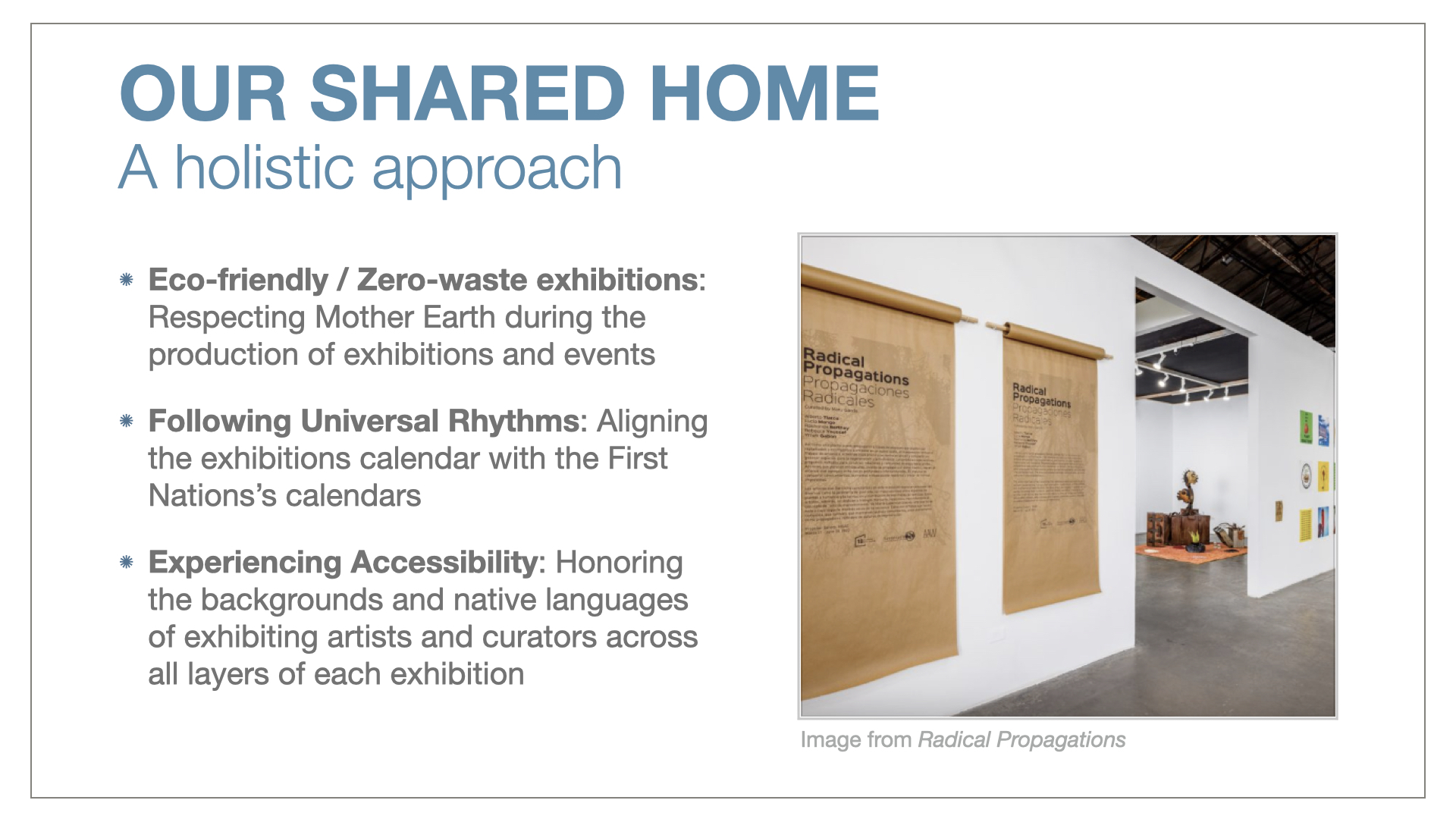
Our Shared Home consisted of an unprecedented change in the paradigm for exhibition making: producing zero-waste / eco-friendly public programs in alignment with First Nations calendars (Tongva, Maya, and Aztec). I didn’t want this theme to simply be a conceptual guidance, instead, I wanted to push the boundaries of exhibition making and understand from the get-go the true implications of addressing our Mother Earth through contemporary art. This push turned the project into a five-year long narrative about Our Shared Home, from 2020 to 2025.
The project envisioned 30 exhibitions in total, in other words in 30 chapters of this story in which about 100 artists would be sharing their ideas about planet Earth, how we currently live in it, how we take care of it (or not), and how we relate to our Mother Earth. Because I had an incomplete exhibitions calendar left from the former director, I tried my best to honor the contacted artists and integrated most of them into this new framework. In two and a half years, Our Shared Home received a total of 16 grants as well as the support by 18th Street Arts Center’s generous Board members and donors (see the complete list of sponsors at the end of the text).
Chapter 1 deepens into the crisis that humanity was facing: the Covid-19 pandemic. How was the pandemic seen through the lenses of contemporary visual artists? Would artists be sharing some insights on how to deal with it? This chapter narrates how police violence (from the exhibition «To Protect & Serve?«), long lists of fears from vulnerable populations (from the exhibition «Milk Debt» by Patty Chang), as well as a hopeless nostalgia coming from not being able to return to our idea of «home» from the past (from the exhibition «Incurable Nostalgia» by Nung-hsin Hu), were among the most impactful episodes from this first chapter.


By the same token, other artists and curators created more resilient approaches to the chapter: this is how it earned its name. Recovery Justice meant the ability to overcome fears and crisis, both personally and collectively, to recover and to continue to focus on creating new ways to live life despite adversities. Exhibitions such as «Becoming Atmosphere,» by Beatriz Cortez and Kang Seung Lee, «Building Networks of Empathy» featuring 18SAC’s community of artists, and «Recovery Justice: Being Well» by Sara Daleiden, were some of the efforts that led us to think that we are capable of recovering with justice our well-being.
In Chapter 2, the sub-theme led us to revisit the invisible connections that keep us united, not only between humans but among all living beings. Weaving Unity analyzed how the past, the present and the future draw inspiration for contemporary artists. Exhibitions such as «Our Stories: Revisit the Past & Reimagine Our Future» by Krystal Ramirez & Joey Tong (curators, Getty Marrow intern and Chinese University of Hong Kong intern, respectively), as well as «Collective Acts of Peace» featuring 18SAC community of artists, facilitated the spaces to intertwine ideas and times.
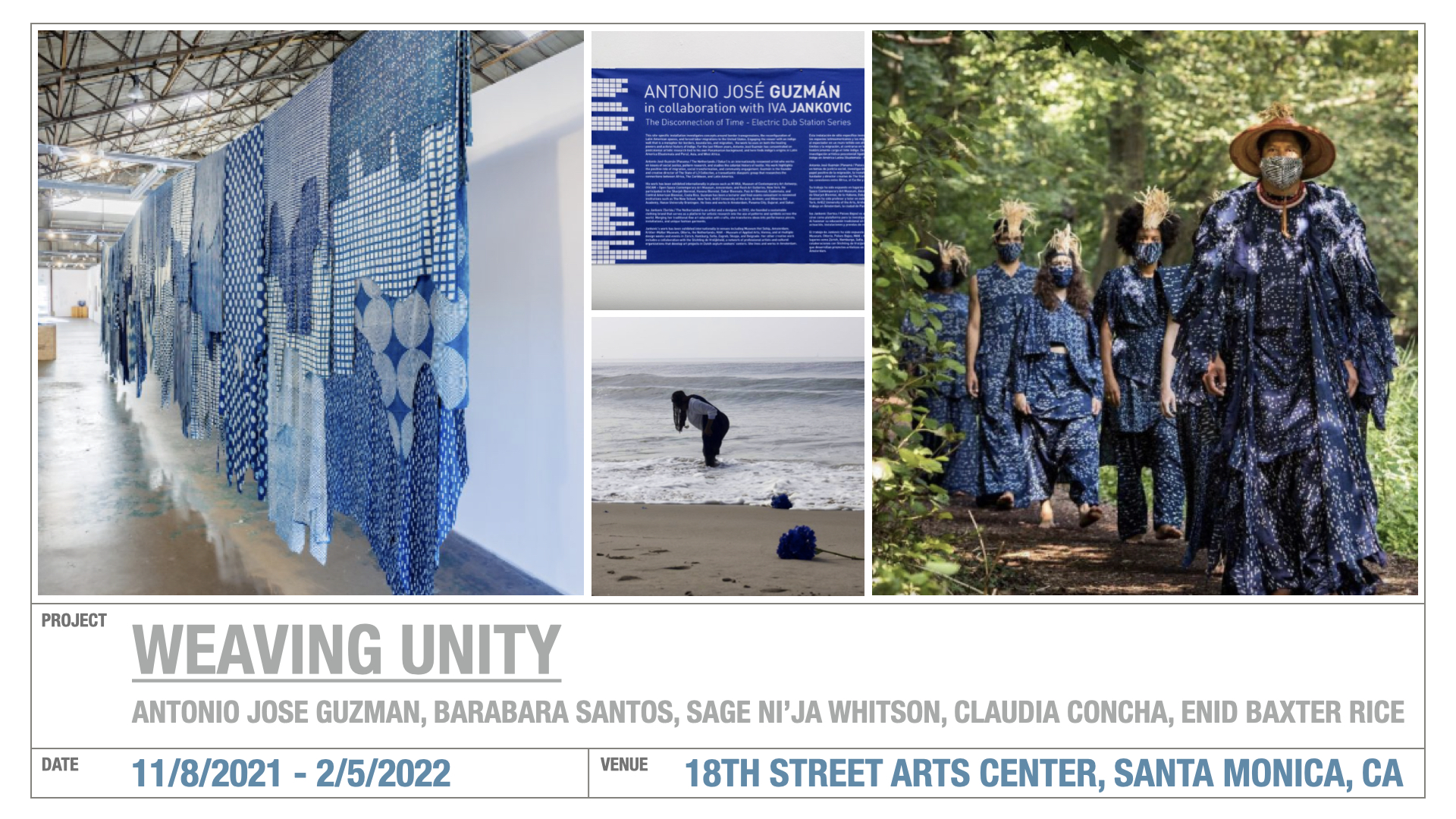

Two of the main exhibitions that addressed the subject of this chapter were «Weaving Unity» and «Radical Propagations» curated by me and Maru Garcia, respectively. «Weaving Unity» focused on how Indigenous voices inspired contemporary artists and permeated their contributions in the featured works. A long-distance performance took place and inaugurated this exhibition by making an offering to Yemaya in the ocean. At the same time, «Radical Propagations» invited artists to collaborate with plants for the creation of the displayed work, propagating the good that environmentally driven artists are doing in today’s troubled world. These two exhibitions achieved the zero-waste goal during their productions and events: no waste was created during the implementation and de-installation because wall texts and labels were reused or recycled, QR codes were used, and all fabric printed banners were upcycled by local artists.
In Chapter 3 of this story, the artists and curators focused on stories in which humans recognized the modes in which we inhabit the world as a shared space. Inhabiting the Geosphere led to exhibitions that addressed climate change and migration.
Artist Ranu Mukherjee «wrote» a beautiful letter in the form of an exhibition entitled «Dear Future» where extinct birds and upcycled materials from previous works in which environmental and social demonstrations were depicted, were transformed into beautiful canvases that served as the background for a two-channel video and live performaces. By the same token, Marvella Muro and Natalie Godinez curated a powerful exhibition called «Imaginary Dwellings» in which every single work narrated a long story about migration and social conflicts, from Palestine, Latin America to Africa and other developing countries and areas from around the globe. How is globalization impacting social mobilization and changing our ideas of what home could be? Similarly, the exhibition «Re-Homing Instincts» featured only women immigrant artists, and first generation of immigrant artists, who struggled yet learned how to make Los Angeles their second home.


All exhibitions achieved the zero-waste goal, and during «Re-Homing Instincts» there was also a dual accomplishment because the event also invited immigrant women vendors, following the same spirit of focusing the attention to immigrant and first generation women warriors. «Re-Homing Instincts» also honored the spoken languages of the exhibiting artists, translating all exhibition-related texts into the seven languages that these women speak. Visitors, from abroad as well as local, were able to experience this exhibition in their own language, following the standards of language justice. Filmmaker Arthur James also created four short films for this exhibition where he featured the artists interacting with the ocean while they were describing their practices as immigrant artists. The ocean played a symbolic element in the films because it connects us all despite geographical distances.
Unfortunately, a few months before the opening of «Re-Homing Instincts,» I learned that I was going to be replaced with a white curator who was a friend of the Executive Director, someone who in the end declined the job offer because she accepted a more lucrative position at a more prestigious museum. The ED offered me to continue curating a reduced number of the exhibitions without any compensation. I declined this offer and, after a long and deep depression, I eventually quit the organization. I spent a total of four and a half years at 18SAC. My last day coincided with the October 2023 eclipse as I took it as a transition between chapters in my life.
After 21 exhibitions of deepening into the vicissitudes of the interactions with the world, it was time to honor our roles as daughters and sons of the same Mother. This is what Becoming Indigenous to the World was for this fourth chapter, because we needed to acknowledge that despite geo-political boundaries and differences: we all are born in the same place, we are all indigenous to this planet and as such, we need to become caretakers of our world.
«Rinsing the Bones» by Jenny Yurshansky was envisioned as a transitional show in which the artist would lead the reading of the general story starting from her upbringing –in which she was born stateless during her parents migration in Europe– to focusing on healing individual and collective trauma so we can grow into a healthy society.
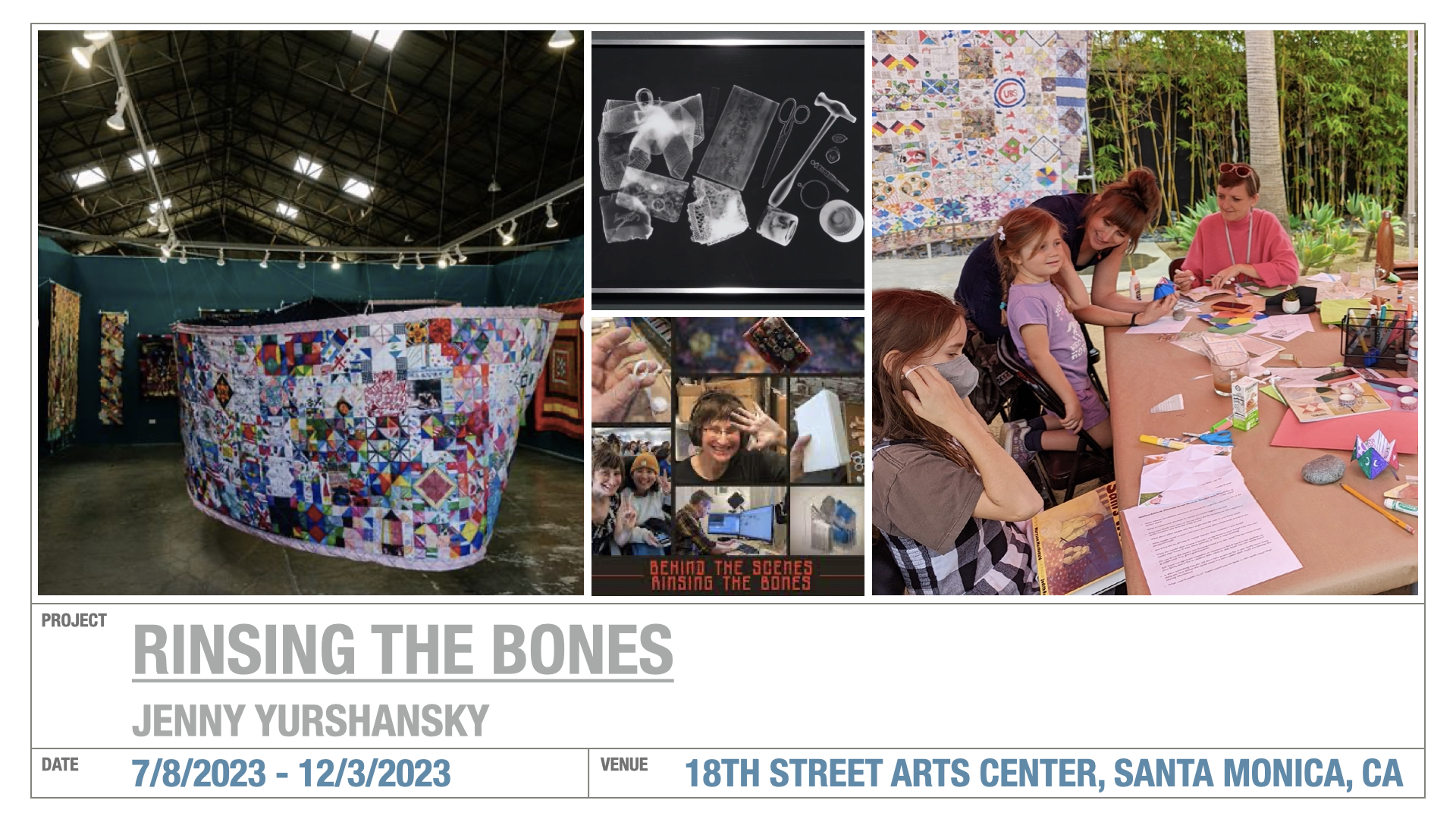
Even though 18SAC hired an external curator to produce the exhibition «Rinsing the Bones,» I learned that the organization wasn’t properly taking care of the artist or her project in many levels, before and during the exhibition. A month after I quit the job, I learned from curator Alma Ruiz that artist Luis Flores have decided to cancel his exhibition with 18SAC, following his intuition and artistic sense. On a large scale, 18SAC disrupted the exhibitions calendar by not following the Universal flows of energy stated in the First Nations’s calendars that served as the foundation for the project Our Shared Home. The organization also canceled an upcoming exhibition that was thought to be the main show for this chapter without notifying the invited Indigenous artists of the change. It would seem that even at a small arts organization, aspects of colonization and exploitation that devastate Indigenous communities and lands continue to drive decisions that blindly affect many people.

Chapter 5 was thought to approach our home from a God’s point of view: from outer space. In the Fall of 2024, the Getty Foundation celebrates its second PST edition under the theme of Art+Science, inviting all LA-based art venues to exhibit art under the theme. Back in 1980s, Jan Williamson, 18SAC’s Executive Director, participated in a project that depicted a satellite view of the world without clouds, a first in its kind. A team of artists and scientists led by Tom van Sant, with technical assistance from Lloyd Van Warren, Leo Blume and James Knighton, created the GeoSphere image that is now very familiar in world Atlas. For the ED, this exhibition was a must, so I integrated it as one of the key moments of the story of Our Shared Home. I thought that after recognizing and honoring the Indigenous perspectives on our planet Earth, a monographic exhibition on Tom van Sant’s GeoSphere curated by Janet Owen Driggs entitled «Eyes on Earth» would follow, deepening and completing a holistic approach of our world.

A couple of other guest curated exhibitions would be closing this last chapter on how we learned to love our world, honoring the past and future, as we work towards a better version of humankind in which individuals assume their roles as caretakers of the world in present time.
Our Shared Home was conceived to empower BIPOC artists and local cultural producers. At the same time, this project allowed 18SAC’s Development and Advancement, Communications, Public Programs and Engagement Departments to conceive new ideas and perform them in unique ways: creative freedom was at the forefront of this project for everyone involved. This initiative opened the opportunity for the staff to hone their expertise, leading the organization into an expansion of new audiences and attraction of new sources of funding. I ensured that artists were also partnered with like-minded organizations for their continued professional growth –for instance, partnering artist and activist Maru Garcia with Sustainable Works for the creation of long-term regenerative art+community projects. In my role not only as the Director but as the leader of the project, I ensured to regularly build trust and creatively solve problems along with staff, board members, and the communities for which the organization works.
As an artist, I also envisioned the creation of a book, a big Atlas-scrap book compiling all the stories that we lived as we co-produced and co-wrote the story of Our Shared Home. All pages of this book were thought to be made from recycled paper coming from the exhibition labels and wall texts, following the zero-waste and eco-friendly motivations that developed and improved as the project grew. A performatic reading / happening by 18SAC staff, board members and artists were thought to occur during the last days of the 2024-2025 Fiscal Year to finalize the story. The recycled paper was thought to have seeds from native plants and the idea was to return all the efforts done in those five years of exhibitions back to the land by planting the paper as a way to thank Mother Earth for giving us a home for us all.
Only a fraction of what I described from Chapter 4 to Chapter 5 will happen. In the Fall of 2023, 18SAC hired a new external curator who was told to produce exhibitions for 2024 onwards, arguing that the calendar was empty.
The lessons I got from this experience are numerous, most of them quite painful. At the same time, I’m grateful for this period because I was able to produce a large-scale project for an art venue in a very unique way because everything was performed and made honoring Mother Earth. Because this project is a collective story, I would like to highlight the names of some of the amazing individuals who shared with me their thoughts and support because they could see and helped me understand situations that I wasn’t even able to name. From 18SAC I want to thank Tom, Melissa, Joyce, Lucia, Jose, Sue, Anu, Brian, Gretchen, Sydney, Kevin, Janine, Joan, Malindi, and Dan, from 18SAC artists thank you to Debra, Yrneh, Hell, Labbie, Sage, Luciana, Marcus, Nung-Hsin, Ling-lin, and Ara, as well as exhibiting artists like Galia, Amanda, Iman, Maria Adela, Enid, Antonio, Gazelle, Jenny, Jackie, Maru, and amazing curators like Alma, Natalie, Marvella, Daniela, Holly, Karen, and Irene, my exhibition collaborators like Lulu, Anna, Marc, Asad, and of course, my family and friends who listened to my frustrations and my best ideas, and who supported me unconditionally, I treasure their insights and guidance, their human connection that they offered me when I was sad. To ALL of them, thank you!
In retrospective, I think that I stayed at this job for so long not only because 18SAC is a great place for artists to feel supported by a community of like-minded people, but also because my mom got sick that year and I needed a regular income to support her from afar. This act in itself makes me think of all the things that parents do for their kids, and how all their sacrifices make their children good citizens of the world when they are adults. Our Shared Home is a homage to Mother Earth and my mom and a way to say «thank you for giving me life and look at all the good things that I’m doing for our home.»
Our Shared Home is a tough place to live in because its beauty also come with its counterpart, and both need to be acknowledged and embraced. The initial inspiration for the project came from the text Laudato si’ in which a mix of scientific, political, environmental and religious texts informed a story where the reader finds awareness of the call from Mother Earth. Every exhibition allowed me to deepen into my research, expanding it beyond the Western knowledge and integrating, not only into my project by also into my personal life, the wisdom from Indigenous cosmologies.
Our Shared home is the place that we inhabit, and all living beings around us are our siblings. I would like to finish this story with a quote from one of the many sources of inspiration for this project in which it is shown that reality can be co-created when there is joined intentions and good will:
Much was made last year about the positive environmental effect of the pandemic as more people stayed home, pollution levels dropped, animals began to reclaim habitats, and the logical that many observers seemed to make is that the Earth was better off without humans. I reject that leap. The Earth may be better off without certain systems that we have created but we are not those systems, we don’t have to be at least. What if I told you that the Earth needs us? What if I told you that we belong here? What if I told you that I’ve seen my people turned deserts into gardens? What if these human hands and minds could be such a great gift to the Earth that they spark new life wherever people and purpose met? —Lyla June, Dine Tribe
The following is the original list of exhibitions that were scheduled for this project, led by Fiscal Years in which each one of them had a sub-theme that revisited the main theme.
| OUR SHARED HOME: The Earth from Space | FY 2024-2025 |
| Exhibition curated by Monica Jun Hye Yeon and Ara Oshagan | 4/28 – 7/12, 2025 |
| Guest curated show (Debra Scacco/Kōan Jeff Baysa) | 1/27 – 3/29, 2025 |
| Eyes on Earth (Long-term 18SAC project) | 9/2 – 11/27, 2024 |
| Glider Wall: The Earth from Space | 7/2024-6/2025 |
| OUR SHARED HOME: Becoming Indigenous to the World | FY 2023-2024 |
| Us from Earth: Collective Stories from Turtle Island (curated by Frida) | 4/15 – 8/3, 2024 |
| Alma Ruiz-Guest curated show, featuring Luis Flores | 11/13, 2023 – 3/9, 2024 |
| Jenny Yurshansky, Rinsing the Bones | 8/1 – 10/14, 2023 |
| Glider Wall: Becoming Indigenous to the World | 7/2023-6/2024 |
| OUR SHARED HOME: Inhabiting the Geosphere | FY 2022-2023 |
| Re-Homing Instincts (curated by Frida) | 4/22 – 7/1, 2023 |
| Ranu Mukherjee, Dear Future (Long-term 18SAC project) | 9/6, 2022 – 3/4, 2023 |
| Imaginary Dwellings (Marvella Muro & Natalie Godinez, curators) | 7/25 – 12/3, 2022 |
| Kitchen Lab: (Re)imagining Home: On Care for Our Common Home (curated by Emma Balda and Venus Tung-yan Lau) | 8/22 – 7/2023 |
| Glider Wall: Inhabiting the Geosphere | 7/2022-6/2023 |
| OUR SHARED HOME: Weaving Unity | FY 2021-2022 |
| Propagaciones radicales (Maru Garcia, curator) | 3/14 – 7/30, 2022 |
| 18SAC, Collective Acts of Peace | 3/14 – 6/4, 2022 |
| Ling-Lin Ku, The Practice of Disguise | 11/15 – 12/17, 2021 |
| Weaving Unity (curated by Frida) | 11/8, 2021 – 2/5, 2022 |
| Cognate Collective, Manos a la Obra | 10/25, 2021 – 2/5, 2022 |
| Jennifer Chia-ling Ho, How are you? | 8/16 – 9/24, 2021 |
| Krystal Ramirez & Joey Tong (curators), Our Stories: Revisit the Past & Reimagine Our Future | 8/2, 2021 – 1/15, 2022 |
| Maj Hasager & Quinn Research Center, Three Structures Touching | 7/26 – 10/2, 2021 |
| OUR SHARED HOME: Recovery Justice | FY 2020-2021 |
| Elana Mann, Year of Wonders, redux | 3/29 – 7/2, 2021 |
| Sara Daleiden, Recovery Justice: Being Well | 3/8 – 9/11, 2021 |
| Emma Skinner (curator), Symbolic Consciousness | 1/20 – 6/18, 2021 |
| Beatriz Cortez & Kang Seung Lee, Becoming Atmosphere | 10/26, 2020 – 2/5, 2021 |
| Nung-hsin Hu, Incurable Nostalgia | 11/18, 2020 – 1/22, 2021 |
| Patty Chang, Milk Debt | 10/19, 2020 – 1/22, 2021 |
| 18SAC, Building Networks of Empathy | 10/26 – 12/15, 2020 |
| CSPG, To Protect & Serve? Five Decades of Posters Protesting Police Violence | 8/24 – 10/2, 2020 |
| 18SAC, Facing Darkness, online show | 6/27, 2020 – 7/30, 2021 |
Photos shown in this post were taken by Marc Walker, Sasha Renee, Jenny Yurshansky, Antonio Jose Guzman, Elana Mann, Nietzscia Marrufo, and me. Cover image with artwork by Lucia Monge.
Our Shared Home was supported by the National Endowment for the Arts, the Mike Kelley Foundation, LA Arts Recovery Fund, Los Angeles County Department of Arts and Culture, Pasadena Arts Alliance, California Arts Council, the Danish Arts Foundation, Santa Monica City Cultural Affairs, Art of Recovery from the City of Santa Monica, the Warhol Foundation, the Mondriaan Fund, Instituto Distrital de las Artes – Idartes, Alcaldía Mayor de Bogota, D.C., Arttextum, Tejido de agentes culturales inspirados en Latinoamérica, Taiwan Academy in Los Angeles and the Ministry of Culture of Taiwan, Artists At Work program –a collaboration between THE OFFICE performing arts + film, and 18th Street Arts Center’s generous Board and donors.
 frida cano
Un comentario en “Our Shared Home”